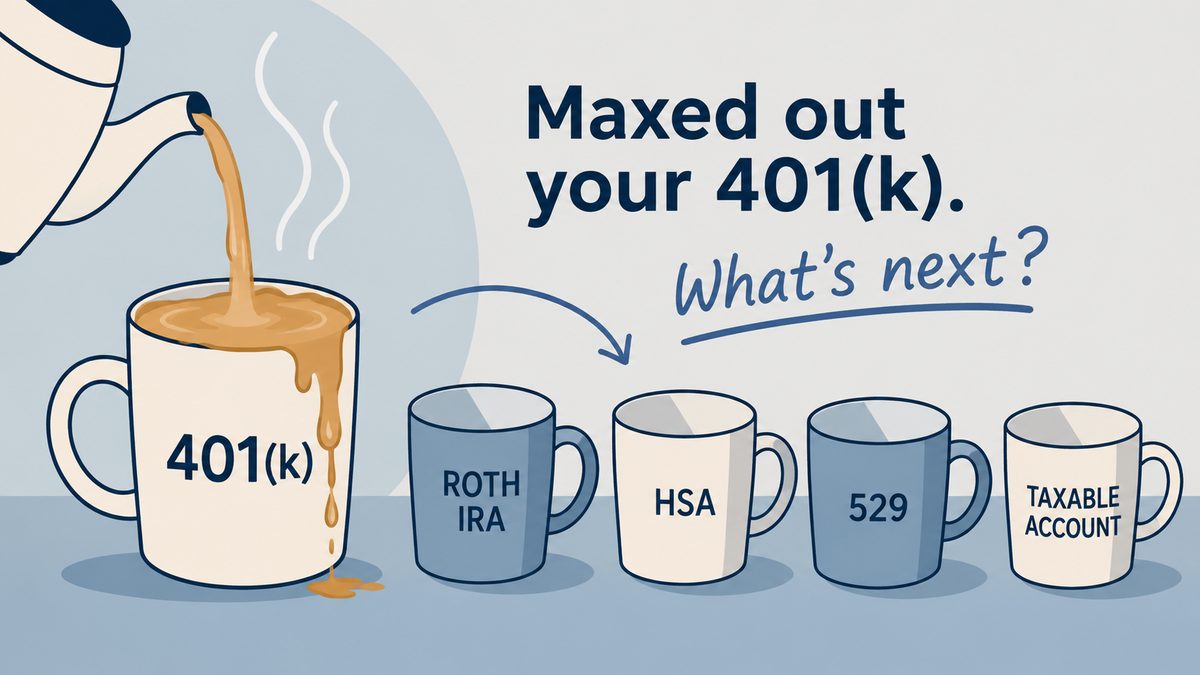
I’ve maxed out my 401(k). What’s next?
You’ve reached the annual 401(k) limit. Where should the next dollar go?
You’ve built consistency, stayed disciplined, and reached your annual 401(k) limit. That’s an achievement worth recognizing. But once you’ve maxed out, where should your next dollar go? At Rosefinch, we help clients think beyond the box, so your savings continue to work efficiently across every stage of life.
I. The power of the 401(k)
For 2025, you can contribute up to $23,500 to your 401(k). It remains one of the most powerful wealth-building tools in the US, combining tax-deferred growth with potential employer matching contributions.
If you’re 50 or older, you can add an extra $7,500. And for those aged 60 to 63, that limit increases to $11,250 (if your plan allows). Once you’ve reached the cap, it’s time to look at complementary strategies that expand your flexibility and tax efficiency.
II. Add tax-free flexibility with a Roth IRA
A Roth IRA allows after-tax contributions, with tax-free growth and withdrawals in retirement. For 2025, the contribution limit is $7,000 (plus $1,000 if you’re 50+).
- Single filers: phase-out begins at $150,000 MAGI, ending at $165,000
- Married filing jointly: phase-out from $236,000 to $246,000
If your income is above these thresholds, a Backdoor Roth conversion may still provide access to Roth benefits, a strategy we often help high-earning clients evaluate.
III. Harness the triple tax advantage of an HSA
If you’re on a High-Deductible Health Plan, a Health Savings Account (HSA) can play a powerful role in long-term wealth planning:
- Tax-deductible contributions
- Tax-deferred growth
- Tax-free withdrawals for qualified medical expenses
Unused funds roll over indefinitely. After age 65, you can even use them for non-medical expenses, taxed like an IRA, but without penalties.
IV. Employer extras worth exploring
Some employers offer additional ways to grow wealth:
- Employee Stock Purchase Plans (ESPPs): buy company stock at a discount.
- Deferred Compensation Plans: defer income and tax into future years.
Each can complement your 401(k) and broaden your overall planning options.
V. Advanced planning: IUL or VUL
For higher-income earners or those seeking additional tax-advantaged flexibility, certain types of life insurance, such as Indexed Universal Life (IUL) or Variable Universal Life (VUL), may supplement your retirement plan.
These policies can:
- Build cash value with potential market-linked growth
- Offer tax-deferred accumulation
- Provide downside protection and a death benefit
They’re not replacements for traditional retirement accounts, but in the right circumstances, they can add diversification and access to tax-efficient income later in life.
VI. Invest in education with a 529 plan
If education is a priority, 529 plans allow you to grow funds tax-free for tuition, fees, books, and housing, from primary school through postgraduate study.
You can even transfer unused funds to another beneficiary, such as a sibling or grandchild. Many plans cover accredited universities abroad, including institutions across the UK and Europe, making them an excellent tool for globally minded families.
VII. Beyond investing: strengthen the foundation
Once you’ve optimized savings, true financial health goes beyond portfolio performance:
- Pay down high-interest debt
- Invest in health and wellbeing
- Consider property or philanthropic goals
Because ‘what’s next’ isn’t only about returns, it’s about purpose, balance, and long-term security.
Let’s talk strategy
If you’ve maxed your 401(k) and are wondering where to go next, Rosefinch can help you design a strategy that aligns with your goals, risk tolerance, and global lifestyle. A first call is the place to explore how your next dollar can work harder, without losing sight of what matters most.